
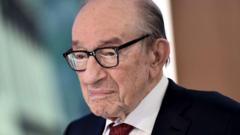
A Legacy in Economic Leadership
Alan Greenspan, the former chairman of the US Federal Reserve, has died at 100 years old, as confirmed by his wife, Andrea Mitchell. Mitchell reported that Greenspan's death was due to complications from Parkinson's Disease. She described him as a 'giant of a man' who significantly influenced the US economy for decades under various presidential administrations, acknowledging his willingness to admit mistakes.
From 1987 to 2006, Greenspan held the influential position of Federal Reserve chairman, a role often considered second only to the presidency in importance. During his nearly two-decade tenure, he oversaw one of the longest periods of sustained economic growth in the United States. Often referred to as the 'God in the machine' of American finance, Greenspan maintained a private demeanor, rarely granting interviews but captivating financial markets with his public statements.
Early Life and Influences
Born in New York City on March 6, 1926, Alan Greenspan was raised by his mother. Contrary to his later career, he initially pursued music, studying clarinet at the Juilliard School of Music and performing with jazz musicians like Stan Getz. This experience offered him practical insights into American business. While touring, he dedicated his time to studying economics and managing the band's finances.
At 19, he enrolled at New York University to study economics, where he became a proponent of free-market principles. His career began in economic consulting and included a board position at JP Morgan. A significant influence in his life was his meeting with novelist and philosopher Ayn Rand in 1952. Greenspan adopted her belief that society thrives when individuals pursue self-interest, famously criticizing the 'welfare state' in a 1966 article as a mechanism for governments to 'confiscate the wealth of the productive members of a society.'
A Career in Public Service
Greenspan's entry into government began with advising Richard Nixon during his 1968 presidential campaign, eventually leading to his appointment as head of the Council of Economic Advisers. His success in curbing inflation impressed subsequent presidents. Gerald Ford retained him at the Council, and Ronald Reagan appointed him to lead a commission on reforming America's state pension system. In August 1987, Reagan elevated him to chairman of the US Federal Reserve, making him one of the most powerful global figures for the next two decades.
Navigating Economic Crises and Growth
Greenspan's leadership was immediately tested by the October 1987 stock market crash. His confident statements and facilitation of cheap credit were credited with calming markets and supporting banks. This approach, later known as 'quantitative easing,' was repeatedly deployed during subsequent crises, including the 1980s savings and loan crisis, the first Gulf War, and the Mexican peso crisis.
He was reappointed by George H.W. Bush and, surprisingly, by Democratic President Bill Clinton. Under Greenspan's guidance, the late 1990s saw a 'golden era' of economic growth. Greenspan praised Clinton's focus on long-term economic growth in his memoir, while expressing concern over some Republican administrations' public spending.
His personal life included an early marriage, a relationship with TV star Barbara Walters, and his marriage to Andrea Mitchell in 1997.
Challenges and Criticisms
Greenspan faced further challenges, such as the 1997 Asian financial crisis, which he addressed by cutting US interest rates to aid the global economy. Similarly, after the dot-com bubble burst in 2000, he described the market's behavior as 'irrational exuberance.' While the Federal Reserve adjusted interest rates, critics like Nobel laureate Paul Krugman argued that Greenspan's low-interest-rate policies contributed to the bubble's growth. After the 9/11 attacks, he drastically cut interest rates to stabilize the US economy.
Greenspan retired in 2006 after an unprecedented five terms. A year later, the US housing market experienced a downturn, leading to the sub-prime mortgage crisis and the most severe global economic downturn since the Great Depression. Critics attributed this crisis partly to Greenspan's low-interest-rate policies post-9/11, which fueled a surge in house prices and aggressive mortgage lending. His aversion to bank regulation and complex financial instruments was also cited as a contributing factor.
In October 2008, Greenspan publicly acknowledged a 'flaw' in his free-market ideology, admitting he had placed too much faith in the financial industry's capacity for self-regulation. He confessed to Congress that banks had disproven his anti-regulation views, stating, 'I have found a flaw. I don't know how significant or permanent it is. But I have been very distressed by that fact.'
Lasting Influence and Later Years
Alan Greenspan is remembered as a central figure in shaping the modern US economy. For two decades, he was seen by many as a financial guru and a bulwark against economic hardship. His extraordinary career earned him the Presidential Medal of Freedom and an honorary knighthood. He remained an influential economic adviser and media commentator into his late 90s, criticizing policies of the Trump administration and Brexit, and commenting on interest rate policies under the Biden administration shortly before his centenary in March 2026.
Greenspan's legacy is marked by his long stewardship of the US economy, during which GDP contracted only once. Despite this, his philosophical opposition to regulation and the two major market crashes that occurred during or shortly after his tenure remain points of contention for his critics.
Source: Alan Greenspan, architect of the modern American economy, dies aged 100