
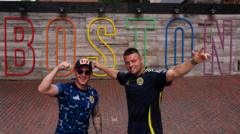
Scottish Supporters Leave Indelible Mark on Boston
Over the past week, an estimated 50,000 Scottish football fans, affectionately known as the Tartan Army, have descended upon Boston, leaving a memorable impression on the city. Their presence, coinciding with Scotland's two group stage matches, has not only boosted local businesses but also fostered a unique cultural exchange, endearing them to Bostonians.
As the fans prepare to depart for Florida following their upcoming match against Morocco, many locals express sadness at their impending departure. The Tartan Army's lively antics, from singing and dancing at Fenway Park to playing bagpipes in residential areas, have been widely documented and shared online, captivating the city's residents.
Economic Boost for Local Establishments
The influx of Scottish supporters has provided a significant economic boost to Boston's hospitality sector. Devon Savage of Boston Beer, which operates the Samuel Adams Taproom, reported an extraordinary surge in sales. She noted, "From Thursday to Sunday, the Tartan Army consumed four times the amount of Boston Lager we typically sell during a major holiday weekend like the 4th of July." This demand necessitated an "emergency delivery" of beverages, with over 3,000 pints of Boston Lager sold and 70 empty kegs collected on Monday alone.
Other local pubs also experienced record-breaking sales, surpassing revenues from major events such as the Super Bowl and St. Patrick's Day. Sean Hemenway, a 28-year-old Boston resident and owner of a classic football strip store, observed a remarkable increase in sales of Scotland merchandise. "By 2:45 PM on game day, we had sold 67 units," he stated, highlighting that even USA strips lagged significantly behind. Hemenway also noted a trend of Bostonians purchasing Scotland tops after interacting with the fans, a rare display of allegiance to another country's team. He half-jokingly remarked, "Once the Scots are gone, it'll be a day of mourning. You guys are a part of Boston now."
Cultural Exchange and Enduring Connections
Beyond the economic benefits, the Scottish visitors have brought a vibrant energy and warmth to Boston. A social media-organized gathering in Boston Common attracted hundreds of locals and Scots, who exchanged Irn Bru and Root Beer while chanting "No Scotland, No Party."
Steve Castigilone, 30, from Boston, shared his sentiments: "I have completely fallen in love with Scottish people. They've made the cold-hearted Bostonians all warm up. You have brought so much joy to our city and we don't ever want you to leave. I'm not a soccer fan, but I'm now a dedicated Scotland fan."
Christian Harrington, 21, from a Boston suburb, echoed this sentiment, stating, "This is a great sports city, but I think the energy has been low. If our sports teams aren't doing well, the city is sad. But having you guys here has changed that. You came at such a good time, we needed it. I'm starting a petition to have it renamed from New England to New Scotland."
Signs of this appreciation are evident throughout the city, with locals frequently waving, greeting, or shouting encouragement to anyone wearing Scotland merchandise. Many attribute this strong connection to the "warmth" and "energy" of the Tartan Army, alongside historical Celtic ties. There are even calls for this "cultural exchange" to become a regular event, with many Americans expressing plans to visit Scotland in the near future.
In a gesture of goodwill, the Massachusetts governor signed an executive order to legalize haggis in the state, though it remains federally banned. Mayor Michelle Wu expressed her gratitude, stating she "feels lucky" Boston hosted two Scotland games. "We hope that Tartan Army see Boston as their base for a long time to come," she added. The possibility remains that if Scotland advances in the coming games, the Tartan Army could make a return to Boston.