
Moscow Confronts War's Proximity After Refinery Strike
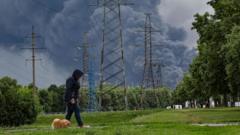
A recent drone assault targeting an oil refinery in southeastern Moscow marked a significant moment, as the conflict with Ukraine, which once seemed distant to many in the Russian capital, visibly impacted the city. Thick, acrid smoke billowed from the damaged facility, casting a dark pall over the skyline and presenting a surreal scene for residents.
Despite the dramatic visual, observations near the site revealed a surprising degree of normalcy. Individuals continued their routines—an angler fished by a pond, children played in a playground, and shoppers frequented a supermarket—suggesting that for some, the extraordinary might be evolving into a new normal.
Impact and Casualties
The attack on Thursday was among the most substantial aerial incursions into the Moscow region since Russia's full-scale invasion of Ukraine. Beyond the oil refinery, the strikes also reportedly affected shopping centers and residential buildings. The governor of the Moscow region stated that an eight-year-old girl died in a fire attributed to one of the drone incidents.
A resident named Slava, living opposite the refinery, expressed a lack of complete surprise but noted the unexpected scale of the assault. He described hearing explosions and witnessing dense smoke from his apartment, likening the scene to something typically seen in films.
However, another local, Nadezhda, voiced deep concern and shock. She questioned the prolonged nature of the conflict, especially given Russia's resources, expressing dismay that the war had reached their city.
Official Response and Media Narrative
The Russian authorities' response to the attack, particularly regarding public sentiment and questions about the war's duration, has been notable. While Russian officials frequently attribute the continuation of the conflict to Western support for Kyiv, President Vladimir Putin did not publicly address the drone assault on Thursday. Russian state media initially provided minimal coverage.
Subsequent reporting in Russian newspapers, however, revealed a consistent narrative aimed at the domestic audience. This message typically emphasized that while Russia faces challenges, Ukraine's suffering is comparatively greater due to Russian military actions. Publications like Komsomolskaya Pravda, Moskovsky Komsomolets, Rossiyskaya Gazeta, and Kommersant all echoed the sentiment that Russian strikes on Ukraine's military infrastructure are more powerful and effective.
Kremlin spokesperson Dmitry Peskov later reinforced this message, urging reporters to focus on footage depicting the results of Russian strikes on Ukrainian cities, stating that these operations would continue.
Economic Pressure and Future Outlook
Despite the official stance, there are indications that Ukrainian drone attacks, particularly those targeting Russian oil facilities, are exerting economic pressure. Reports of petrol shortages, rationing, and rising fuel prices in some parts of the country suggest an impact on the Russian economy.
The prevailing sentiment in Moscow, as reflected in local media, is that more drone strikes are to be expected. Moskovsky Komsomolets predicted that the June 18 attack would not be an isolated incident. A Moscow resident, observing the smoke, conveyed a sense of resignation, stating, "It's our government that must decide what to do. All we can do is watch."
Source: Moscow oil refinery attack brings Russia's war with Ukraine closer to home