
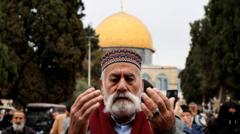
Tensions Rise Over Jerusalem's Holy Site Governance
The delicate balance governing the al-Aqsa Mosque compound in Jerusalem, a site sacred to both Muslims and Jews, is reportedly under strain. Israeli nationalist figures are increasingly challenging the decades-old 'Status Quo' agreement that dictates religious practices at the site, leading to heightened concerns about potential instability.
Moshe Feiglin, a prominent right-wing Israeli politician, was observed praying and singing religious songs at the al-Aqsa compound, an act that contravenes the existing understanding. Feiglin openly expressed his aspiration for a new Jewish temple to be constructed on the site, which has served as a pivotal Islamic holy place for over 1,400 years.
The Significance of the Al-Aqsa Compound
Known to Muslims as al-Haram al-Sharif (Noble Sanctuary) and to Jews as the Temple Mount, the 35-acre compound is one of the most iconic landmarks in the Middle East. It is dominated by the gold-covered Dome of the Rock and holds profound religious importance for both faiths. Islam considers al-Aqsa as the place from which Prophet Muhammad ascended to Heaven, and it is traditionally reserved exclusively for Muslim prayer.
For Judaism, the site is equally significant, believed to be where the First and Second Jewish Temples stood. Jews typically pray at the Western Wall below the compound, mourning the destruction of the temples by the Romans nearly 2,000 years ago.
Understanding the 'Status Quo'
The 'Status Quo' is an informal agreement established decades ago, entrusting the custodianship of the al-Aqsa compound to the Jordanian-administered Islamic Waqf (Endowment). Under this arrangement, non-Muslims are permitted to visit the site but are explicitly forbidden from praying or performing religious rites there. Furthermore, the Chief Rabbinate of Israel and most ultra-Orthodox rabbis prohibit Jewish prayer on the site based on halachic (Jewish legal) principles. Actions by individuals like Feiglin directly challenge these long-standing conventions.
Reports of Proposed Changes and International Reactions
Recent reports have indicated discussions between Israeli and US officials about potentially altering the Status Quo, with suggestions that the compound could be declared a "multi-faith centre." These reports, notably from Middle East Eye, also hinted at the possibility of allowing large-scale Jewish prayer and a gradual Israeli takeover of the site's governance. The US Secretary of State, Marco Rubio, stated he had "no knowledge" of such reports when questioned, although prominent US figures, such as Ambassador Mike Huckabee, have often emphasized Jewish ties to holy sites in Jerusalem and the West Bank.
The Israeli prime minister's office has consistently maintained that there has been no change to the Status Quo. However, Dr. Mustafa Abu Sway, Deputy Head of the Islamic Waqf Council, expressed grave concerns, warning that any formal alteration would be akin to "opening a Pandora's box" and could jeopardize regional peace.
International bodies and nations, including Jordan, Gulf countries, Egypt, and the British government, have voiced alarm regarding any erosion of Islamic authority at al-Aqsa, emphasizing the need to respect the historic arrangements.
Nationalist Momentum and Historical Precedents
Despite international warnings, some Israeli nationalists believe they have momentum. Israel's far-right National Security Minister, Itamar Ben-Gvir, a frequent visitor to al-Aqsa, has been seen in videos chanting nationalist slogans and unfurling an Israeli flag at the compound, acts that directly contravene the Status Quo. Ben-Gvir has reportedly utilized his ministerial position to facilitate Jewish prayers and songs in certain areas of the compound, signaling a desire for increased Jewish and Israeli control.
Historical events underscore the sensitivity of the site. In September 2000, Ariel Sharon, then a right-wing Israeli opposition leader, visited the al-Aqsa compound with armed police. This act was widely seen as provocative and is considered a catalyst for the Second Palestinian Intifada, a period of intense violence that resulted in thousands of casualties.
"Peace without leaving al-Aqsa Mosque alone, is simply opening a Pandora's box. It is jeopardising the peace in the region, and it pitches everyone against everyone," says Dr. Mustafa Abu Sway.
The current pressures to alter the administration and ownership of this highly sensitive site raise fears of a similar disastrous escalation, highlighting the critical importance of maintaining stability at the al-Aqsa compound.
Source: Status quo at Jerusalem's holiest site under threat as Israeli nationalists flout rules