
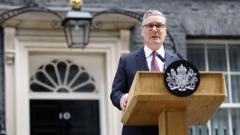
Keir Starmer Steps Down as Prime Minister and Labour Leader
Sir Keir Starmer has announced his resignation as Prime Minister and leader of the Labour Party. In a speech delivered today, Starmer reflected on his two years in office and the six years he spent revitalizing the Labour Party.
A Look Back at Labour's Journey and Achievements
Starmer began by recalling the immense pride he felt two years ago when Labour formed a new government, ending a 14-year period out of power. He emphasized that his entry into politics was driven by a desire to improve the lives of millions.
He highlighted the challenging path to power, noting that six years prior, the Labour Party was in a state of political, financial, and moral disarray. Despite widespread skepticism about the party's future and its ability to secure a majority, Starmer asserted that they had defied expectations.
"I inherited a Labour Party that was politically, financially and morally bankrupt... We proved those people wrong because we changed our party."
Starmer credited this turnaround to significant internal reforms, including eradicating antisemitism, rebuilding trust in economic management, defense, and national security, and re-establishing the party's connection with national identity.
He then enumerated key achievements during his two-year tenure as Prime Minister:
- A stronger economy with growth surpassing international peers.
- Consistent wage increases outstripping inflation.
- Increased investment and infrastructure development.
- An end to austerity measures.
- The fastest reduction in NHS waiting lists in 17 years.
- Significant improvements in rights for workers and renters.
- The largest increase in defense spending since the Cold War.
- A reduction in small boat crossings and the closure of asylum hotels.
- Measures to protect young people from harmful social media content.
- Lifting half a million children out of poverty.
- Restoration of Britain's international reputation, advocating for decency, respect, and the rule of law.
- Securing trade agreements and strengthening alliances, particularly with Ukraine and European partners.
Transition of Leadership
Despite these accomplishments, Starmer acknowledged a shift in the party's focus. He stated that while questions about his ability to transform the Labour Party and lead it to power had been answered, the current inquiry within the party concerned his suitability to lead them into the next general election.
Accepting the parliamentary party's perspective, Starmer confirmed his decision to resign, asserting that every choice he made prioritized the country's best interests. He informed His Majesty the King of his decision and outlined the process for selecting his successor.
The National Executive Committee of the Labour Party will establish a timetable, with nominations opening on July 9th and concluding before the summer recess. This schedule aims to have a new leader in place before Parliament reconvenes in September. Starmer will remain as Prime Minister until the leadership contest is complete, ensuring an orderly handover of power and offering his full support to his successor.
He concluded by expressing gratitude to his colleagues, staff, and the civil service, and shared his intention to dedicate more time to his family, particularly his wife, Vic, and his children.
Source: Prime Minister Keir Starmer's resignation speech in full