
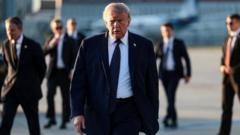
Initial Agreement Reached Between US and Iran
US President Donald Trump and Iranian President Masoud Pezeshkian have formally signed a preliminary peace agreement, signaling an immediate cessation of hostilities. This initial accord, reached during the G7 summit in France, aims to de-escalate the conflict that began on February 28.
Key Provisions of the Deal
- Strait of Hormuz Reopening: The agreement mandates the immediate reopening of the Strait of Hormuz, a crucial global trade route that controls a significant portion of the world's oil and liquefied natural gas (LNG) supply.
- Iranian Reconstruction Plan: A substantial $300 billion (£224 billion) initiative for Iran's reconstruction is included.
- Sanctions Termination: The US has committed to ending "all types of sanctions" against Iran.
Despite these significant steps, the contentious issue of Iran's nuclear program, which the US cited as the primary reason for the conflict, is to be negotiated over an extendable 60-day period. The memorandum of understanding states that Iran reaffirms its commitment not to acquire or develop nuclear weapons and that its enriched uranium will be diluted on-site under the supervision of the IAEA, the UN's nuclear watchdog.
Leaders' Perspectives and Concerns
President Trump defended the agreement, asserting it would prevent an "economic catastrophe" and a "worldwide depression." He also issued a stark warning, stating the US would "bomb the hell" out of Iran if a final deal failed to materialize. Iranian President Pezeshkian confirmed the signing, while Iran's parliamentary speaker, Mohammad Bagher Ghalibaf, expressed ongoing distrust of the US. Ghalibaf stated, "If the enemy does not understand the language of logic, we will enter again with the language of power," and indicated that the Strait of Hormuz might not return to its pre-war, charge-free status after 60 days.
Economic Impact and International Reactions
The announcement of the agreement saw a dip in oil prices, with Brent crude falling approximately 1% in early Asia trading, though it remained higher than pre-conflict levels. The deal's provisions for the Strait of Hormuz include no charges for ships for the first 60 days, with the possibility of future charges, a departure from pre-conflict conditions.
The peace plan has drawn mixed reactions, particularly in the US. Republican Senator Bill Cassidy criticized it as "the worst foreign policy blunder in decades." Senator Ted Cruz questioned the $300 billion fund for Iran, calling it unwise to give funds to a regime he described as "theocratic lunatics." US officials, however, clarified that the $300 billion fund does not involve direct US payments to Iran, but rather facilitates potential investments from other nations if Iran adheres to the agreement. Trump himself dismissed reports of the US giving money to Iran as a "fake story" but acknowledged that frozen Iranian assets should eventually be returned.
Democrats also expressed strong reservations. New Hampshire Senator Jeanne Shaheen deemed it "a very bad deal," arguing it failed to address critical issues such as Iran's support for regional proxies or its missile program. She contended that the agreement did not achieve the goals President Trump set at the war's outset.
Israel's Stance and Regional Dynamics
The agreement also addresses the "immediate and permanent termination of military operations on all fronts, including in Lebanon." However, Israel has indicated no plans to withdraw troops from Lebanon and continued attacks on Hezbollah. President Trump, expressing concern that Israeli military operations could jeopardize the deal, admonished Israeli Prime Minister Benjamin Netanyahu at the G7, urging a "softer touch" in their actions.
Source: Trump and Iran's president sign initial deal aiming to end war