
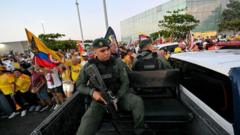
Escalating Violence Shapes Colombian Election Narrative
Colombia's long-standing internal conflict, involving various armed groups, the state, and drug cartels, has become a central issue defining the country's presidential election. The pervasive insecurity is deeply impacting citizens, with many recounting personal experiences of displacement, extortion, and violence.
Edilma Martinez Flores, who fled her home near Cali after armed groups threatened residents, shared her ordeal: "My brother was murdered for not paying an extortion payment...in front of his children." Her story reflects a broader trend of escalating violence and forced displacement that is influencing voters' priorities.
A Deepening Crisis
While Colombia's conflict has spanned six decades, recent years have seen a notable resurgence. Illegal armed groups, including FARC dissident factions, the National Liberation Army (ELN), and the Clan del Golfo, have reportedly doubled their membership in the last five years. These groups have expanded their control in rural areas, particularly those vital for drug trafficking and illegal mining. A brutal offensive between the ELN and FARC dissidents near the Venezuela-Colombia border last year led to the displacement of tens of thousands.
Isabelita Mercado Pineda, a government advisor, noted a 300% increase in forced displacement between 2024 and 2025, a level not seen in two decades. She attributes this surge to factors such as increased cocaine production, the failure of the army to secure territories vacated by FARC after its 2016 demobilization, and perceived shortcomings in the government's peace strategy.
Contrasting Visions for Peace and Security
The two leading presidential candidates offer markedly different strategies to address the violence. The campaign has been marred by assassinations, kidnappings, and bombings, underscoring the urgency of the issue.
Iván Cepeda: The Path of Negotiation
Left-wing senator Iván Cepeda is closely associated with the current president Gustavo Petro's "total peace" strategy, which prioritizes negotiation with armed groups. Supporters argue this approach prevents greater loss of life, while critics contend it has allowed armed groups to exploit ceasefires and expand their influence. Cepeda played a significant role in the 2016 peace deal that disarmed thousands of FARC fighters. He has pledged "social transformations" and to "take stock" of the existing peace strategy, making necessary adjustments.
Younger voters, such as student Catalina La Grande, tend to favor Cepeda's approach. She stated, "Cepeda's proposal for security not only contemplates the coercive forces of the state to stop crime, but also takes into account the structural roots of insecurity - the lack of state presence, poverty, inequality, many young people belonging to criminal groups."
Abelardo de la Espriella: A Firm Hand
His conservative challenger, businessman and lawyer Abelardo de la Espriella, known as "El Tigre," advocates for a tough military crackdown and an end to negotiations with armed groups. Endorsed by Donald Trump, de la Espriella has promised to build 10 mega-prisons and to confront criminals decisively, stating, "Any criminal who does not surrender will be taken down."
De la Espriella enjoys strong support in Colombia's Caribbean coast. Maria Luisa Sanchez, a family friend, described him as a man with "very strong convictions," possessing the "character, courage...we need for Colombia, a person...who is tough on drug-trafficking, tough on guerillas." Supporter Sandra Caballero echoed this, highlighting his commitment to working with the United States to combat drug trafficking and his rejection of negotiations with criminals.
Personal Accounts of Suffering
The human cost of the conflict is evident in stories from victims. Erin Gamboa from the Chocó region shared that his half-brother was taken by FARC guerrillas and has not been heard from since. He described his region as "heavily contested," with criminal gangs fighting over illegal mining and cocaine trafficking sites. Another anonymous couple recounted being extorted by someone claiming to be from the FARC, demanding a significant sum for their children. The woman tearfully expressed how crime has escalated, making it impossible to "go out in peace anymore."
The outcome of Sunday's election will significantly impact how Colombia addresses its deep-seated internal conflict and the lives of its citizens.
Source: Colombia's escalating, brutal internal conflict is defining its presidential election