
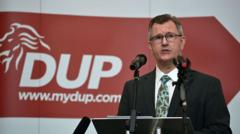
A Political Career's Abrupt End
Sir Jeffrey Donaldson's extensive political career, marked by significant moments in Northern Irish politics, concluded dramatically with his conviction on serious charges. Once lauded as a key figure in restoring power-sharing at Stormont, his public life came to an abrupt end with his arrest and subsequent guilty verdict.
Donaldson's political journey began in 1985 with the Ulster Unionist Party (UUP), representing South Down in the Northern Ireland Assembly. He previously worked for MP Enoch Powell. His ascent continued when he secured the Lagan Valley MP seat in 1997 following James Molyneaux's retirement.
The Good Friday Agreement and Party Defection
A pivotal moment in Donaldson's career was his dissent from the 1998 Good Friday Agreement. He walked out of talks, opposing his party's support for the peace deal, particularly over issues like IRA decommissioning. This disagreement set him on a path of increasing criticism towards the UUP leadership, especially David Trimble.
In 2003, his dissatisfaction culminated in his defection to the Democratic Unionist Party (DUP). This move coincided with the DUP surpassing the UUP as the largest party in the Northern Ireland Assembly, a position it has maintained since. Within the DUP, Donaldson quickly rose, transitioning from a figure of protest to a prominent policymaker and media presence.
Parliamentary Influence and Leadership Challenges
Donaldson served as an MP for 27 years, developing a reputation for understanding Westminster dynamics. A notable period was in 2017 when, as the DUP's chief whip, he played a crucial role in the confidence-and-supply agreement that supported Theresa May's minority Conservative government. However, the DUP's influence waned with Boris Johnson's premiership, particularly regarding the Irish Sea border issue.
In 2021, following Arlene Foster's ousting, Donaldson contested the DUP leadership, initially losing to Edwin Poots by a narrow margin. Poots' brief tenure, however, ended in an internal party revolt, paving the way for Donaldson to become leader unopposed.
Navigating Post-Brexit Challenges and Return to Power-Sharing
As DUP leader, Donaldson faced immediate challenges, particularly concerning post-Brexit trade arrangements for Northern Ireland. In September 2021, he threatened to withdraw the DUP from power-sharing if demands were not met, a threat he actualized six months later. While this strategy bought time and alleviated pressure from unionist rivals, the party lost seats in the May 2022 Northern Ireland Assembly election, with Sinn Féin becoming the largest party.
Despite the signing of the Windsor Framework in February 2023, the DUP initially refused to back it. However, by October, Donaldson began signaling a return to devolution. After intense negotiations and considerable pressure, he secured party backing in February 2024 to re-enter power-sharing, a move that was seen as a significant political victory.
Conviction and Party Aftermath
Just weeks after this political triumph, which included a celebratory visit to Washington D.C., Donaldson was arrested and charged with sexual abuse. He resigned as DUP leader, and his party membership was suspended. On Monday, Donaldson was found guilty of all 18 charges, including rape.
The conviction sent shockwaves through the DUP, forcing them to manage the fallout while preparing for a general election. The party, under new leader Gavin Robinson, acknowledged the impact of Donaldson's demise, particularly on their performance in the 2024 General Election, where they lost three seats. The party now faces a period of recovery and rebuilding ahead of the next assembly election in 2027, grappling with the lasting shadow of its former leader's downfall.
Source: From Parliament to prison - the fall of Jeffrey Donaldson