
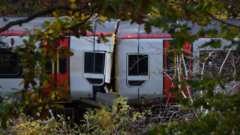
Investigation Highlights Preventable Factors in October 2024 Train Crash
A recent investigation has concluded that a head-on train collision in mid Wales, which resulted in one fatality and four serious injuries, might have been avoided. The incident occurred in October 2024 in the village of Talerddig, Powys.
The Rail Accident Investigation Branch (RAIB) determined that the crash would likely not have happened if either the automatic or manual sanding systems, designed to enhance wheel adhesion to the rails, had been engaged. Transport for Wales (TfW) and Network Rail acknowledged the report's findings, stating that while such incidents are "extremely rare," they would review the recommendations to "help prevent a similar incident."
Details of the Fatal Collision
The collision claimed the life of 66-year-old Tudor Evans from Capel Dewi, Aberystwyth, who was returning from a holiday. He was a passenger in the rear carriage of the westbound train, along with other seriously injured individuals. The driver of the eastbound train from Shrewsbury also sustained serious injuries, becoming trapped as he attempted to exit the cab.
Both trains, operated by Transport for Wales, were on the Cambrian Line, which predominantly features a single track but includes a dual-track section known as the Talerddig Loop where the crash occurred. The trains were intended to pass each other within this loop. However, on the evening of October 21, 2024, at approximately 19:00, the Aberystwyth-bound train failed to stop despite full brake application.
Investigators found that the train slid through the loop, re-entering the single-track section and continuing down a slope towards the oncoming train. The Aberystwyth train was traveling at 24mph at the moment of impact, while the Shrewsbury train, whose driver had managed to slow down after a warning from the signaller, was moving at 6mph.
Sanding System Failures and Environmental Factors
The RAIB report attributed the inability to stop to the failed sanding systems and low wheel-rail adhesion. Both trains were equipped with an automatic sander, designed to activate during braking, and a manual emergency sander. The investigation revealed that the automatic system likely malfunctioned due to electrical faults, and the driver did not activate the manual emergency sander, reportedly not realizing its necessity or the failure of the automatic system.
Adverse weather conditions, specifically damp railhead conditions from earlier rain, were also identified as a significant contributing factor, reducing adhesion between the wheels and tracks. Other elements like leaves can also impact rail adhesion.
Recommendations and Reactions
The RAIB issued nine recommendations, focusing on improving passenger carriage safety, enhancing sanding system design and safety, addressing wheel-rail adhesion conditions, and upgrading driver training. Specifically, the report recommended that Transport for Wales review training to ensure drivers are competent in emergency procedures, including making emergency calls and using emergency sanding systems. It also suggested that all on-train staff should possess the skills and knowledge to assist in an emergency.
Bethan Evans, a passenger on the Aberystwyth train who was knocked unconscious, recounted the chaotic scene: "I remember looking around and seeing people in panic, I heard defibrillator noises, I heard people shouting, I saw people on the floor, and broken bones." She emphasized the need for more staff with first aid training to assist casualties before emergency services arrive.
Local resident Peter Lamb, who heard the collision, described a "sea of emergency vehicles" in the usually quiet village, expressing sorrow for those affected.
Plaid Cymru Senedd member Elwyn Vaughan stressed the importance of learning from this "highly unusual" event to prevent future tragedies. Transport for Wales and Network Rail reiterated their commitment to safety and pledged to consider the report's recommendations.
Dave Calfe, general secretary of ASLEF, the train drivers' union, noted that drivers are typically instructed not to deploy sanders over points and questioned whether sanders would have stopped the train in time regardless. He extended his condolences to the victim's family and those injured.
Source: Train crash that killed one man and injured four others could have been avoided