
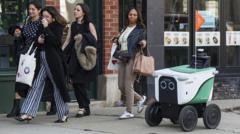
Public Backlash Against Autonomous Delivery Vehicles
The increasing presence of autonomous urban delivery vehicles, commonly known as delivery robots, on city sidewalks worldwide is generating a mixed response. While some initially viewed these robots as a futuristic innovation, a growing number of residents and local officials are expressing significant concerns.
John Roberts, a Chicago resident, initially found the sight of delivery robots impressive. However, his perspective shifted after an incident where he and his family had to move out of the way for a robot on a pedestrian walkway. He voiced worries about the potential for numerous robots to overcrowd sidewalks, impacting the walking experience for families.
Safety and Accessibility Issues Highlighted
These robots, which navigate using cameras, sensors, and GPS to transport goods like groceries and fast food, are operational in various cities across the US, UK, Japan, South Korea, and Germany. Companies operating these robots assert their ability to safely navigate and avoid obstacles, contributing to reduced traffic and emissions. However, reports from the public suggest otherwise.
Roberts has launched a petition in Chicago, accumulating approximately 4,400 signatures, to suspend robot operations until safety tests are conducted and clear regulations are established. He cites instances of pedestrians having to step into streets to avoid robots, reports of minor collisions and injuries, and robots causing traffic disruptions or blocking emergency vehicles due to erratic behavior at crosswalks.
Similar concerns have arisen in Glendale, California, where the city council is contemplating a temporary ban. Council member Ardy Kassakhian noted the robots' unannounced appearance and the lack of clarity regarding regulatory authority. He highlighted issues with accessibility on narrow sidewalks, recounting personal observations of stand-offs between robots and elderly pedestrians, and broken-down robots creating obstructions. Glendale is seeking a comprehensive regulatory framework that includes operating rules, insurance requirements, accessibility standards, and accountability for operators.
Regulatory Landscape and Job Market Impact
The regulatory environment for delivery robots varies globally. While some nations like South Korea and Japan have adopted a more liberal approach, other areas are implementing restrictions. San Francisco has limited robot access to less congested areas, and Toronto has prohibited them from using sidewalks since 2021. Chicago has also banned the machines from two specific city zones.
Beyond pedestrian safety, concerns extend to the potential impact on employment. The Independent Workers Union of Great Britain (IWGB), representing delivery drivers, is monitoring the situation closely and has voiced its concerns to the government. Alex Marshall, president of IWGB, expressed worry that widespread robot deployment could lead to significant job losses, particularly affecting precarious workers in communities dependent on delivery services.
Despite current limitations, analysts from Transforma Insight predict a substantial boom, projecting 2.1 million delivery robots in operation worldwide by 2034. As these autonomous vehicles become more prevalent, the debate over their integration into urban environments and the necessary regulatory frameworks is expected to intensify.
Source: 'We had to get out of the way': The backlash over delivery robots