
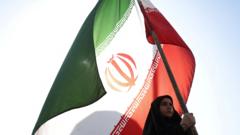
Tehran's Official Narrative: A Victory for Resistance
Iran's leadership is actively presenting its emerging memorandum of understanding (MoU) with the United States not as a concession, but as a direct outcome of sustained resistance and a strategic victory. This narrative comes at a challenging time, following a period of conflict, significant economic strain, and dissent even within the Islamic Republic's traditional support base regarding any compromise with Washington.
Senior Iranian officials have publicly lauded the agreement. Mohammad Bagher Qalibaf, the Speaker of parliament and a key figure in the negotiations, declared that Iran had moved "a long step towards final victory." President Masoud Pezeshkian echoed this sentiment, suggesting the understanding could be transformative, potentially resolving many of Iran's issues and ushering in "a different world" for Iran and the broader Middle East if fully implemented. Qalibaf's endorsement is particularly noteworthy, as he is not aligned with Pezeshkian's moderate faction, indicating broader support for the deal from influential segments of the system, including within the Islamic Revolutionary Guards.
The leadership's argument for victory centers on the assertion that the US and Israel failed to achieve their primary objectives. According to Tehran, they neither forced Iran into surrender, removed the Islamic Republic from power, ended its nuclear program through military force, nor severed its ties with Hezbollah. Instead, Iran remains engaged in diplomatic discussions, with Lebanon included in the framework and the prospect of sanctions relief on the table.
Internal Contestation and Economic Realities
Despite the official narrative, the deal faces considerable internal opposition. A hard-line Member of Parliament, serving as the deputy chair of parliament's National Security Committee, reportedly criticized the draft agreement as a document that would reduce Iran to an "American colony." He also accused negotiators of disregarding the Supreme Leader's directive against reopening the Strait of Hormuz to shipping. Such criticism, originating from within a national security oversight institution, underscores significant internal divisions.
For months, hard-line voices in parliament, state-affiliated media, and pro-government gatherings have expressed deep distrust of the US, citing past instances where diplomacy preceded military actions. For these factions, any deal with Washington risks being perceived as appeasement. However, a noticeable reduction in the volume of these criticisms could suggest that the decision to proceed with the deal has received authorization from the highest echelons of the state. This does not imply full unity but rather a potential calculation by the center of power that the costs of rejecting the agreement outweigh the costs of absorbing hard-line discontent.
Economic pressure is a crucial factor in this calculation. While Iran's leadership may present the agreement as leverage gained through military actions, including pressure on the Strait of Hormuz and attacks on regional energy interests, the dire state of the economy has undoubtedly played a significant role. The war, sanctions, shipping restrictions, limited access to oil markets and hard currency, and rampant inflation have severely impacted the country and its citizens. For many Iranian families, the primary concern is not whether the agreement represents a victory, but whether it will alleviate economic hardship and reduce the threat of further conflict.
US Vice-President JD Vance has clarified that Iran would not receive taxpayer money but could gain access to billions of dollars if it fulfills its commitments and sanctions are eased. This allows Tehran to frame the deal as a pathway to investment and reconstruction, rather than dependency on America.
Uncertainties and Regional Dynamics
The details of the memorandum are not yet fully public, and negotiations are set to continue in Switzerland. Complex issues such as the future of Iran's enriched uranium, permissible enrichment levels, verification mechanisms, sanctions relief, the status of Hormuz, and Lebanon remain central to the discussions. The situation is further complicated by regional dynamics, particularly concerning Israel.
Israeli Prime Minister Benjamin Netanyahu has denied reports of an Israeli withdrawal from southern Lebanon, stating that Israeli forces will remain as long as necessary. Simultaneously, Donald Trump has publicly criticized Israel's actions in Lebanon, expressing dissatisfaction with a strike on Beirut shortly before the Iran-US deal was reached, while still affirming his relationship with Netanyahu. For Tehran, this visible friction between Washington and Israel can be leveraged as evidence that Iranian pressure has constrained Israel's operational freedom. However, it also highlights the fragility of the agreement. Continued Israeli operations in Lebanon could compel Iran to respond, and Washington's ability to restrain Israel will be a critical test of Tehran's assertion that Lebanon is covered by the memorandum.
Feedback from BBC Persian's audience indicates a mixed reception to the official victory narrative. Some expressed deep concern about potential Israeli attacks and a lack of trust in the government's ability to manage the country effectively, even with the agreement. Others, who initially supported US military action for regime change, questioned the actual benefits of the conflict, pointing to increased misery, inflation, and economic damage without achieving political change. Conversely, some viewers were more sympathetic to the government's stance, viewing Iran as the victor and arguing that sanctions are lifted through power, not supplication. Others cautiously welcomed the agreement, seeing it as a temporary reprieve that offers much-needed breathing space and calm for people to return to their lives.
This pragmatic view—that the deal offers a temporary respite—may be the most realistic assessment. The Islamic Republic presents the agreement as a victory because it is difficult to frame it as a necessity. However, for many Iranians, its true success will not be measured by official slogans but by tangible improvements: an end to conflict, easing prices, the arrival of sanctions relief, and the leadership's capacity to navigate the next phase without another sudden escalation.
Source: Tehran selling deal with US as victory – but for Iranians it was necessity