
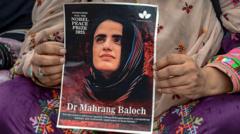
Baloch Activist Faces Life Sentence
Dr. Mahrang Baloch, an activist who has tirelessly campaigned against enforced disappearances in Pakistan's south-western province of Balochistan, has been handed a life sentence by an anti-terrorism court. The verdict, delivered on Monday, convicted Baloch and fellow activist Sibghatullah Shah on charges including terrorism, sedition, and murder, related to the death of a paramilitary soldier during a 2024 protest in Gwadar.
Baloch and Shah vehemently deny the charges, and their legal team intends to appeal the decision in higher courts. Mahrang's sister, Nadia Baloch, who is part of her legal defense, expressed the family's defiance following the ruling. However, Nadia also shared her personal struggle, stating she lacks the courage to visit her sister in prison, feeling she has failed to secure justice for Mahrang.
A Personal Crusade Against Disappearances
For 33-year-old Mahrang, the issue of enforced disappearances is deeply personal. Her father, Abdul Ghaffar Langove, a political activist, vanished in 2009 when she was 16. Nearly three years later, his body was discovered in Lasbela district, bearing signs of torture. This traumatic experience profoundly shaped her life and fueled her commitment to activism.
Over the past two decades, activists and human rights organizations allege that thousands of ethnic Baloch individuals have disappeared, many reportedly detained by security forces without due process or subjected to abduction, torture, and killing amid operations against a separatist insurgency. The Pakistani government refutes these claims, asserting that many missing persons have joined separatist groups or left the country. While some return traumatized, many never do, and others are found in unidentified graves across Balochistan.
"When my father's body arrived, he was wearing the same clothes, now torn. He had been badly tortured." - Mahrang Baloch in a pre-arrest interview.
Mahrang became a prominent voice in the movement, particularly highlighting the plight of women whose lives are defined by the search for their missing relatives. Nominated for the Nobel Peace Prize last year, she has become one of the most recognizable leaders advocating for answers and accountability.
The Struggle in Balochistan
Balochistan, Pakistan's largest province, is rich in natural resources such as gas, coal, copper, and gold. However, it remains one of the country's least developed regions, marked by poor infrastructure, sporadic electricity, and water scarcity. Access to many areas is restricted for security reasons, and foreign journalists are often barred from visiting.
The province became part of Pakistan in 1948, a move that faced opposition from some tribal leaders who sought an independent state. This resistance evolved into militancy, fueled by accusations that Pakistan has exploited the region's resources without investing in its development. Militant groups like the Balochistan Liberation Army (BLA), designated a terrorist organization by Pakistan, the United States, and others, have intensified attacks in recent years.
Enforced disappearances are widely believed to be a tactic employed by Islamabad to suppress the insurgency, quash dissent, and weaken nationalist sentiment. While many of the missing are suspected members or sympathizers of Baloch nationalist groups, a significant number are ordinary citizens with no known political affiliations.
Government officials, including Balochistan's Chief Minister Sarfraz Bugti, deny widespread enforced disappearances, labeling such claims as "systematic propaganda" and suggesting "self-disappearances" also occur. Pakistan's government states that approximately 80% of over 2,900 disappearance cases reported in Balochistan since 2011 have been resolved. Activists, however, estimate the number of disappearances to be much higher, around 7,000, though verifiable data remains elusive.
The intensity of enforced disappearances escalated after 2006, following the killing of Baloch leader Nawab Akbar Bugti in a military operation, which sparked increased anti-state protests and insurgent activity. The government's subsequent crackdown led to a rise in both disappearances and the discovery of unidentified bodies.
A Legal Battle and Unwavering Resolve
Mahrang Baloch, a trained doctor, gained prominence through the Baloch Yakjehti Committee (BYC), a movement advocating against enforced disappearances, alleged human rights abuses, and for greater control over Balochistan's natural resources. She organized protests, led long marches, and became an influential voice despite facing death threats, legal challenges, and travel bans.
Supporters view her as a peaceful human rights campaigner, while critics, including state officials, accuse her movement of promoting separatist narratives, allegations she has consistently denied. In an interview before her arrest, Mahrang stated her campaign was for the rights of Balochistan's people, seeking "the right to live on our own land without persecution" and an end to "this rule of fear and violence."
In late 2023, she led a 1,000-mile march of hundreds of women to Islamabad, demanding information about their missing family members, and was arrested twice during the journey. Her final arrest occurred in March 2025 in Quetta, during a protest following the burial of 13 unclaimed bodies, feared to be missing persons. Authorities claimed these were militants killed after a train hijacking, though this was unverified.
Mahrang warned that enforced disappearances only fuel further resistance. She consistently called for institutional reforms, emphasizing, "We don't want our children growing up in protest camps. Is that too much to ask?" Her work earned her a spot on the BBC's 100 Women list in 2024 and TIME magazine's TIME100 Next list.
The life sentence represents the most significant challenge to her activism. Her family views it as an attempt to silence dissent, while authorities maintain the case concerns criminal acts. Nadia Baloch has questioned the trial's integrity, citing concerns about changes in legal representation, lack of access to witness accounts, and denial of a fair trial. Despite knowing imprisonment was a possibility, Mahrang's family reports she remains resolute, with her message unchanged: "The struggle will continue."
Source: The woman who fought for Pakistan's disappeared men now faces life in jail