
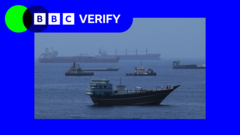
Increased Shipping Activity Observed in Critical Waterway
Following a recent agreement between the United States and Iran aimed at de-escalating regional tensions, maritime traffic through the Strait of Hormuz has seen a notable increase. Data from the maritime intelligence firm Kpler indicates that at least 172 vessels have transited the strait since June 18, the day after the deal was signed. This includes a significant surge of 42 ships on a single Saturday.
Despite this uptick, current transit numbers are still considerably lower than the daily average of approximately 138 crossings observed before the conflict. Ship-tracking information analyzed by BBC Verify on Tuesday showed over 200 tankers positioned within the strait, with at least 10 vessels moving westward into the Gulf.
Oil Prices Decline as Sanctions Ease
The global oil benchmark, Brent crude, has experienced a drop to its lowest price point since the conflict began. This coincides with the lifting of a US naval blockade as part of the new agreement, which has facilitated the movement of Iranian-linked tankers. Jemima Shelley, a senior research analyst at United Against Nuclear Iran, reported that at least 30 tankers carrying Iranian oil and petrochemicals have departed from the Gulf since the deal was reached.
Further easing of restrictions came from the US Treasury, which issued a license permitting the sale of Iranian crude oil, petrochemicals, and other oil products until August 21. On Monday, tracking data revealed that at least five tankers previously sanctioned by the US for their connections to Iran traversed the strait, reportedly transporting up to four million barrels of oil.
Martin Kelly of EOS Risk Group noted an increase in broader commercial trade as well, with four liquefied natural gas tankers observed heading to Qatar's Ras Laffan port and several other cargo and oil vessels sailing out of the Gulf. These transits primarily utilized the Iranian-approved northern route through Iranian waters, rather than the US-recommended southern route.
Challenges and Conflicting Directives Persist
Despite the agreement, which commits Iran to facilitating the safe passage of commercial vessels for 60 days, complexities remain. Iran's Persian Gulf Strait Authority (PGSA), a US-sanctioned entity, published its terms for transit, requiring a valid passage permit. Kelly suggests this requirement may deter some ship owners.
Conflicting messages from Iranian officials have also created uncertainty. While Iran's Islamic Revolutionary Guard Corps (IRGC) announced the strait's closure on one occasion, traffic continued. Later, an Iranian ambassador reportedly stated the strait was open, while a military source suggested daily transit caps.
Concerns about sea mines continue to impact shipping levels. The Joint Maritime Information Center (JMIC), a multinational group, has warned vessels to avoid the central part of the strait due to the presence of mines and has recommended a narrower southern route, which it has confirmed as clear. Shelley observed a brief resumption of southern corridor transits before stalling, with only a trickle of tankers passing through on Tuesday.
Source: Dozens of ships head through Strait of Hormuz after US-Iran deal