
Fear and Intimidation Grips Migrant Communities
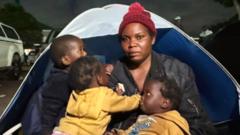
As a June 30th deadline for undocumented migrants to leave South Africa approaches, many foreign nationals are experiencing heightened fear and intimidation. Esnat Joseph, a 36-year-old Malawian mother of triplets, recounted fleeing her home in Durban after a group of ten armed men threatened her family, injuring her husband. She is now among an estimated 7,000 foreigners, primarily Malawians, who have sought refuge in an open field, receiving aid from humanitarian organizations.
Joseph's experience is not isolated. Numerous individuals in the makeshift camp report similar door-to-door threats. These incidents follow a series of protests this year, spearheaded by groups like March and March and the political party ActionSA, which have collectively set the deadline for migrants to depart. Protesters, chanting 'Mabahambe' (Zulu for 'They must go'), assert that their actions are not xenophobic but aimed at upholding the law and prioritizing South African citizens.
President Ramaphosa Urges Calm as Repatriations Begin
President Cyril Ramaphosa addressed the escalating tensions, cautioning against the 'scapegoating of vulnerable people' as a solution to the nation's economic problems. Despite his plea, the anti-migrant sentiment continues to build.
In response to the growing hostility, several foreign governments, including Malawi, Ghana, Mozambique, Nigeria, and Zimbabwe, have begun organizing repatriations for their citizens. Approximately 3,500 foreigners have voluntarily left South Africa in recent weeks. Benjamin, a Nigerian returnee, expressed his relief upon arriving in Lagos after nearly a decade in South Africa, stating, 'South Africans don't like foreigners, especially Nigerians. South Africa is not a place to be - it's a place you can lose your life at any time.'
Economic Hardship Fuels Anti-Migrant Sentiment
South Africa, the continent's most developed economy, attracts millions of migrants seeking employment, yet it grapples with severe economic challenges, including a 32.7% unemployment rate, particularly among youth. Protest organizers argue that undocumented migrants exacerbate these issues by competing for scarce jobs and straining public services.
Jacinta Ngobese-Zuma, a leader of March and March, emphasized the importance of legal immigration, stating, 'If you come into South Africa with a passport that allows you to stay for 30 days. When it's 50 days, when it's two years, when it's five years, you know you're breaking the law.' Critics, however, fear that the current protests could reignite the widespread xenophobic violence seen in 2008, 2015, 2016, and 2019, which resulted in numerous deaths and displacements.
Government Response and Ongoing Challenges
The South African government has introduced a five-point strategy to address illegal migration, including stricter asylum claim policies, naturalization quotas, expanded digital IDs, and penalties for employers hiring undocumented migrants. President Ramaphosa has explicitly condemned xenophobia and warned against individuals or groups demanding proof of nationality in public.
Corruption within the immigration system also remains a significant concern, with some migrants reporting bribing officials to maintain their stay. The government's 'Operation New Broom' has seen informal shops, often run by undocumented migrants, demolished in Johannesburg, further displacing vulnerable communities.
Political parties are also accused of leveraging anti-migrant rhetoric for electoral gain ahead of local government elections in November. Human rights lawyer Sharon Ekambaram highlighted how 'unscrupulous politicians have been using misinformation to fuel fear and anger over illegal migration.'
Despite government efforts to control the narrative and enforce immigration laws, a palpable sense of fear persists among foreign nationals, both legal and undocumented. The looming deadline and the inflammatory warnings from protest leaders have prompted many to consider their immediate departure, with reports of long queues at border posts.
Source: 'We fear for our lives' - deadline for migrants to leave South Africa looms