
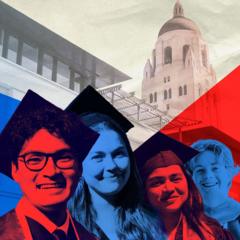
AI Sparks Mixed Reactions at Stanford Commencement
Graduating students at Stanford University, a prominent hub for technological innovation, are confronting the pervasive influence of artificial intelligence (AI) as they embark on their post-academic careers. While some embrace AI's potential, others voice significant apprehension regarding its ethical dimensions, societal impacts, and effects on the future job market.
During a recent commencement ceremony, Google CEO Sundar Pichai, whose company is a major AI developer, delivered an address that was met with a student walkout. Protesting graduates carried signs, some referencing Google's AI contracts with government entities and others displaying Palestinian flags, highlighting broader political and ethical concerns tied to technology's applications.
A Spectrum of Student Perspectives
Stanford occupies a unique position within the tech landscape, with its graduates often gaining a significant advantage in the job market. Despite this, the conversation around AI among its students is far from monolithic.
Ifdita Hasan, a computer science and AI major, expressed optimism, stating, "I think AI gives us the opportunity to learn more about the universe. It's a tool that people should try to use and try to adapt to." She likened current skepticism to initial reactions to the internet, encouraging a more positive outlook.
Conversely, Atash Heil, an Earth Systems major, articulated concerns about the rapid pace of AI's integration and its uncertain future. Heil, who found an AI art exhibit jarring, emphasized the importance of human creativity and ethical development in AI. "It has to be done ethically, and it's not being done ethically these days," Heil remarked.
Impact on Employment and Education
The rise of AI also casts a shadow over employment prospects for recent graduates. Studies, including one from Stanford, indicate a decline in early-career employment in fields highly susceptible to AI automation, such as software development. While Stanford did not provide specific job placement statistics, many interviewed graduates had secured positions or planned further studies.
Academically, AI's presence has led to concerns about "cognitive offloading," where students rely on AI for problem-solving. Lucy Zimmerman, a computer science major and teaching assistant, observed discrepancies between AI-assisted homework and exam performance. This has prompted some courses to reintroduce proctoring and spoken exams to prevent academic dishonesty.
Stanford's Enduring Legacy in Tech
Stanford University boasts a rich history in technological advancement, having played a pivotal role in the development of Silicon Valley. Alumni include Google co-founders Larry Page and Sergey Brin, and the term "artificial intelligence" itself was coined there by computer scientist John McCarthy. The university continues to be a magnet for talent, admitting less than 4% of applicants annually.
Despite the challenges, some students see AI as a potential tool for addressing global issues. Atash Heil, while cautious, believes AI can assist in climate modeling and resilience efforts. However, many, like psychology major Colbey Harlan, worry about the environmental impact of data centers and the unchecked progression of AI. "I'm kind of at a point where it's like – 'Okay, AI is cool, but can we just stop progressing it?' because if we continue, things are going to get out of control," Harlan stated.
The current generation of Stanford graduates finds itself at a critical juncture, navigating a world increasingly shaped by AI, balancing its immense potential with its profound ethical and societal implications.
Source: Stanford was their golden ticket - could AI help or hinder that?