
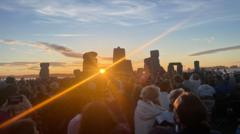
Celebrating the Longest Day
The summer solstice, signaling the official start of astronomical summer in the Northern Hemisphere, was observed with numerous gatherings and activities across the United Kingdom. While commonly perceived as an entire day, the solstice is a precise moment when the Earth's pole reaches its maximum tilt towards the Sun. This year, that exact moment occurred on Sunday, June 21, at 09:24 BST.
Its profound significance is often reflected in ancient monuments and rituals globally. In the UK, various communities participated in events to commemorate this special day.
Sunrise Spectacles and Community Walks
- Thousands converged at Stonehenge in Wiltshire, an iconic site, to witness the sunrise on the longest day of the year.
- In St Martin, Jersey, the sunrise painted a dramatic canvas of red and orange hues, enjoyed by early risers.
- Over 200 individuals participated in a dedicated solstice walk, spanning from The Valley Evesham to the New Farm Nature Reserve in Worcestershire.
Embracing the Waters
Despite varying weather conditions, many embraced the tradition of early morning dips. In Sunderland, County Durham, individuals like Janet Burns, Linda Candlish, Trish Bromley, and Gill Richardson dressed up for the occasion at Roker Beach. Further north, the Hornsea Mermaids made the most of an early swim, even through foggy conditions.
Understanding the Solstice
The summer solstice typically falls between June 20 and 22, often on June 20 during a leap year. This slight annual variation occurs because the Earth's orbit around the Sun takes approximately a quarter of a day longer than our calendar accounts for, a discrepancy addressed by the addition of a leap day every four years. The term 'solstice' originates from the Latin word 'solstitium', which translates to "sun standing still," metaphorically describing the sun's apparent pause at its highest point in the sky before reversing its seasonal direction.
Source: BBC News