
IAEA to Oversee Uranium Dilution
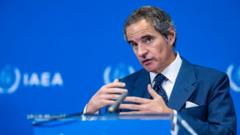
The International Atomic Energy Agency (IAEA) will conduct inspections in Iran as stipulated by the country's preliminary peace agreement with the United States. Rafael Grossi, director general of the IAEA, confirmed in Japan that these inspections are set to occur. He noted that the agreement explicitly mandates IAEA supervision for the dilution of Iran's highly enriched uranium, with details regarding dates, procedures, and locations to be finalized soon.
"The inspections will indeed take place," Grossi told reporters. "We will be working on the modalities - dates, procedures, places - very soon."
This development comes as US Secretary of State Marco Rubio visits Gulf nations to discuss the deal. The initial US-Iran agreement also includes provisions for Iran to allow shipping through the Strait of Hormuz, while the US would lift a naval blockade on Iranian ports. Following the agreement, Brent crude oil prices dropped below $75 (£57) for the first time since the recent US-Israeli conflict with Iran began. The UN also reported that some ships have already traversed the strait as part of a humanitarian effort to evacuate stranded sailors.
Dispute Over Inspection Access
Despite Grossi's assurances, a dispute has emerged between the US and Iran regarding the scope of these inspections. US Vice-President JD Vance had previously stated that Iran agreed to invite IAEA inspectors back into the country. However, an Iranian foreign ministry spokesman later clarified that there had been "no detailed discussions" about granting IAEA inspectors access to nuclear facilities damaged during the recent conflict. US President Donald Trump subsequently dismissed Iran's statements, asserting that the country had "fully and completely agreed" to inspections.
Grossi acknowledged the differing political statements but emphasized the binding nature of the signed memorandum of understanding between the two presidents. He highlighted that the document explicitly states that nuclear activities involving nuclear material and facilities will be supervised by the IAEA, asserting that these inspections "will happen."
However, Iranian Deputy Foreign Minister Kazem Gharibabadi reiterated that access to damaged nuclear facilities and materials would only be addressed within the framework of a final agreement with the US, and only after practical steps to lift all sanctions have been taken. He dismissed "media noise" as an attempt to impose facts on the ground.
Context of the Agreement
Under the 14-point memorandum of understanding, the US and Iran have committed to negotiating a final deal within 60 days. This agreement includes a commitment to resolve the disposition of stockpiled enriched material through a mutually agreed mechanism, with on-site down-blending under IAEA supervision as the minimum methodology.
A recent IAEA report indicated that while inspectors were allowed to visit Iran's Bushehr nuclear power plant earlier this month, they were still denied access to sensitive nuclear facilities bombed in June. This lack of access prevents the IAEA from providing information on the current size, composition, or whereabouts of Iran's enriched uranium stockpile, or whether enrichment activities have been suspended. Much of the stockpile is believed to be in underground tunnels at the Isfahan site.
Before the conflict on February 28, the IAEA reported that Iran possessed 440kg (970 lbs) of uranium enriched to 60% purity, close to weapons grade, theoretically sufficient for up to 10 bombs if enriched further to 90%. Iran consistently maintains that its nuclear program is entirely peaceful and not aimed at developing nuclear weapons.
The current situation echoes the 2015 deal with the US and five other world powers, where Iran agreed to limit its nuclear activities and allow robust IAEA monitoring in exchange for sanctions relief. However, President Trump withdrew from this agreement in 2018, leading to renewed US sanctions and Iran's subsequent breaches of the deal's restrictions, particularly concerning uranium enrichment.
Source: UN nuclear chief says inspectors will visit Iran sites as part of war deal