
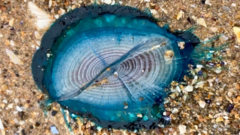
'By-the-Wind Sailors' Spotted on Welsh Beaches
Hundreds of distinctively blue sea creatures, identified as Velella velella, commonly referred to as 'by-the-wind sailors,' have recently appeared on beaches along the Welsh coastline. These free-floating hydrozoans, which are related to the Portuguese man o' war, have been sighted in areas including Anglesey, Gwynedd, and Tenby.
One individual who encountered a specimen on Tenby South beach described its appearance as being "like a crystal." While their beauty is undeniable, marine specialist Frankie Hobro from Anglesey Sea Zoo has issued a caution against touching them due to their stinging cells.
Characteristics and Appearance
The nickname 'by-the-wind sailors' originates from a small, sail-like structure on the creatures that enables them to be propelled across the ocean surface by the wind. Hobro noted that while they are often confused with the more venomous Portuguese man o' war, Velella velella are significantly smaller, possess a brighter blue hue, and are generally considered less harmful.
She elaborated on their visual appeal, stating, "You get the kind of blue tides of the by-the-wind sailors and obviously if they catch the sunlight as well it really sparkles. It's stunningly beautiful." She added that Portuguese man o' war, with their purples and pinks, are even more striking.
Occurrence and Safety Precautions
Typically measuring around 7cm in length, by-the-wind sailors cannot propel themselves and are frequently deposited ashore following storms or shifts in ocean currents. They are relatively common, often appearing in autumn and winter when currents carry them over long distances, leading to large groups stranding together along coastlines.
Despite their generally mild sting compared to the Portuguese man o' war, Hobro strongly advises against touching them. She explained that while the sting might not be felt through thicker skin on fingers, contact with sensitive areas like the lips or face could result in a painful tingling sensation. Furthermore, the stinging cells can remain active even after the creatures have washed ashore and appear lifeless. Therefore, observers are encouraged to appreciate these natural wonders from a safe distance.
Source: 'Stunningly beautiful' blue sea creatures appear on Welsh beaches