
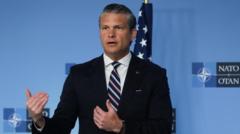
US Defense Secretary Initiates Review of European Forces, Criticizes NATO Allies
US Defense Secretary Pete Hegseth has announced a comprehensive six-month review of American military forces stationed in Europe. Speaking at a meeting of NATO defense ministers in Brussels, Hegseth voiced significant disapproval of certain US allies within the alliance, suggesting that some countries were not contributing adequately to collective defense efforts.
During his address, Hegseth stated, "Some countries will fail, and others will pass with flying colours," implying a performance assessment for NATO members. He specifically called out allies he believes have been "free-riding" on the security provided by the United States. Additionally, the Secretary criticized member states that imposed restrictions on assistance to US forces during the recent conflict with Iran.
NATO 3.0 and Defense Spending Expectations
This announcement follows a prior US decision to reduce its commitments to the NATO Force Model (NFM), a high-readiness component of the alliance. Hegseth referred to the new review as "Nato 3.0," emphasizing its objective to "ensure that Nato is moving fast and irreversibly toward Europe leading" on continental security.
The US is pushing for NATO members to increase their contributions to defense spending in Europe. Washington highlights that some nations have not yet outlined how they plan to meet the agreed-upon target of 5% of national economic output (GDP) dedicated to defense, which includes 3.5% for core defense and 1.5% for related infrastructure. Hegseth explicitly linked US contributions to NATO's annual dues to other countries meeting their spending targets, stating, "where other allies do not spend with urgency, our dues contributions will go down."
"Some of Nato's largest economies, some of our richest countries, allies that are happiest to go on about the rules-based international order and middle powers banding together, still seem to think the era of free-riding is here," Hegseth remarked, though he refrained from naming specific countries.
European Response and Troop Movements
NATO Secretary-General Mark Rutte acknowledged that defense spending among European members had already increased by €90 billion (£78 billion; $103 billion) last year, representing nearly a 20% rise. Rutte affirmed that European nations were "already backfilling" resources that the US was reducing.
While the specifics of US commitment reductions remain undisclosed, they are understood to encompass air and naval capabilities. A senior NATO official conceded that "not everything" the US withdraws "can be absolutely replaced," but Rutte indicated that efforts were underway to address the changes, which are taking effect immediately.
In May, the US announced the withdrawal of 5,000 troops from Germany following disagreements between President Donald Trump and German Chancellor Friedrich Merz regarding the conflict with Iran. Later that month, a plan to withdraw 4,000 troops from Poland was initially announced, then reversed, with a promise of 5,000 troops being deployed instead. Poland, which hosts up to 10,000 US troops on a rotational basis, has offered to provide a permanent base for US forces, a proposal the US is reportedly considering.
Earlier, President Trump had also threatened to halt trade with Spain after its government declined to permit the use of its air bases for attacks on Iran. The US maintains two military bases in Spain: Naval Station Rota and Morón Air Base.
Looking ahead to the Ankara summit on July 7-8, Rutte expressed his expectation for allies to present "clear, concrete and credible plans" to achieve the 5% GDP defense spending target by 2035, ideally ahead of schedule.
Source: Hegseth announces US review of Europe forces, says some allies will fail