
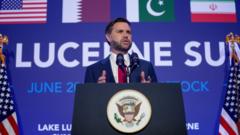
Significant Progress Reported in US-Iran Discussions
US Vice-President JD Vance announced that Iran has consented to the return of nuclear inspectors, a long-standing demand from the international community. He indicated that discussions with the International Atomic Energy Agency (IAEA) could commence as early as today, marking a significant step forward.
Speaking after the first round of talks between the United States and Iran aimed at resolving the ongoing conflict, Vance echoed statements from mediators, highlighting substantial progress. Key topics of discussion included the reopening of the Strait of Hormuz and establishing mechanisms for regional ceasefire de-escalation.
Memorandum of Understanding Outlines Key Commitments
Last week's signed memorandum of understanding (MOU) includes provisions for reopening the Strait of Hormuz and ceasing hostilities on all fronts, encompassing Lebanon. Mediators Qatar and Pakistan, in a joint statement, confirmed that the US and Iran had agreed to a 'roadmap towards reaching a final deal within 60 days' following these initial talks.
Vance described the discussions as having established a 'very good foundation' for future negotiations. He expressed particular enthusiasm regarding the nuclear issue, calling it a 'major milestone for the American people and a first step in permanently... ending a nuclear weapons programme in Iran.' Iran has consistently maintained that its nuclear program is exclusively for civilian use.
Return of Inspectors Expected Soon
When questioned about the timeline for UN nuclear watchdog inspectors returning to Iran, Vance anticipated the process would begin 'at a minimum this week,' with direct conversations with inspectors and the IAEA potentially occurring 'as soon as today.'
The 14-point MOU, signed by US President Donald Trump and Iranian President Masoud Pezeshkian, specifically addresses the IAEA's role in monitoring Iran's enriched nuclear material stockpile. While Tehran denies pursuing nuclear weapons, many nations and the IAEA have expressed skepticism.
Historical Context of Iran's Nuclear Program
In 2015, Iran, alongside the US, China, France, Russia, Germany, and the UK, agreed to the Joint Comprehensive Plan of Action (JCPOA). This agreement limited Iran's nuclear activities and granted the IAEA access to all Iranian nuclear facilities for inspections.
However, in 2018, during his first term, US President Donald Trump withdrew the US from the JCPOA, labeling it a 'bad deal' due to its perceived lack of permanence and failure to address Iran's ballistic missile program. Iran subsequently suspended IAEA access to sites targeted during the June 2025 conflict, leading the UN's nuclear watchdog to withdraw its remaining inspectors the following month.
Ongoing Technical Discussions and Regional Ceasefire Efforts
Iranian media reported that Iran's lead negotiators have departed the talks in Bürgenstock, Switzerland, though technical discussions between the parties are set to continue. The mediators' joint statement also noted the establishment of a 'communication line' to prevent incidents and miscommunication, ensuring safe passage for commercial vessels through the Strait of Hormuz.
Furthermore, both sides agreed to create a 'de-confliction cell' involving the US, Iran, and Lebanon, facilitated by the mediating countries, to end military operations in Lebanon. Iranian Foreign Minister Seyed Abbas Araghchi stated that the Lebanon de-confliction cell would serve as the first 'real test' of the agreement. Despite the initial deal's call for a cessation of fighting on all fronts, recent Israeli airstrikes in Lebanon have resulted in at least 67 fatalities, while attacks by Hezbollah have killed five Israeli soldiers.
Source: Vance says Iran will allow nuclear inspectors back into the country