
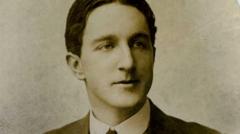
Historical Reunion for Fallen Soldier
The brain of a Scottish soldier who died during World War Two has finally been laid to rest alongside his body in Germany, 85 years after his passing. Donnie MacRae, a private in the Seaforth Highlanders, was captured in June 1940 while fighting in France and subsequently died in a prisoner of war hospital in 1941 at the age of 33.
Discovery of Missing Remains
MacRae suffered from a rare neurological condition, and during a post-mortem examination, his brain and a portion of his spinal cord were removed for research. His family remained unaware of this until nearly 80 years later, when an international team of researchers uncovered the information. These researchers were sifting through records of thousands of brains used in German medical research, aiming to identify the individuals and ensure proper commemoration.
The Ministry of Defence's Joint Casualty and Compassionate Centre (JCCC) played a crucial role in locating MacRae's relatives. Some family members recently traveled to Germany to attend a blessing ceremony marking the interment of the additional remains.
JCCC case worker Nicola Nash commented to BBC Radio Scotland Breakfast, "It gives them closure and gives them the chance to show how grateful they are because they are there because their relative fought and died for them."
Context of Wartime Research
Originally from Gairloch in Wester Ross, Donnie MacRae's body was initially buried by the Germans and later reinterred by the Allies in the Commonwealth War Graves Commission cemetery in Berlin. His brain, however, was sent to the Kaiser Wilhelm Institute for Psychiatry in Munich.
MacRae's brain was among approximately 2,000 specimens collected for research by leading Berlin and Munich institutes during World War Two. This collection included brains from children killed during the Holocaust, Polish Jews and Catholics, individuals with mental illnesses, political prisoners, Belgian resistance fighters, and other French and Polish soldiers. This extensive collection was part of Germany's ambition to lead medical research at the time. About 160 small slices of MacRae's brain and spinal cord had been preserved in the archives of the Munich research center, later known as the Max Planck Institute for Psychiatry.
Source: Original Article